


14th of April 2023, Landing Gear Failure, Blog #742

On the morning of April 14, 2023, a BAe Jetstream 31 operated by Northwestern Air Lease Ltd. departed Fort Smith Airport (CYSM) in the Northwest Territories for a demanding visual flight rules (VFR) training flight conducted under Canadian Aviation Regulations Subpart 704. On board were a captain and a first officer (FO), with the FO acting as the pilot flying as part of ongoing training.

The flight was planned so to cover a wide range of operational scenarios in a single flight. The crew completed takeoff and landing performance calculations, executed a crosswind takeoff, performed steep turns, and practiced four different stall configurations. They also simulated an engine failure at V2 speed at altitude, flew in conditions representative of volcanic ash and turbulence, and conducted a VOR hold while managing a simulated right-engine fire. To accomplish this, the aircraft travelled approximately 61 nautical miles south-southwest toward Peace Point, Alberta, before returning to Fort Smith.
Back at Fort Smith, the crew initiated their final exercise: a VOR Runway 12 approach followed by a circling maneuver to land on Runway 30 under simulated single-engine conditions. This added a significant level of complexity and workload. On final approach to Runway 30, the aircraft was configured with the landing gear down and flaps set to 20°. During the landing flare, the aircraft briefly ballooned, increasing its float above the runway. The captain intervened to correct the flight path, and the FO subsequently completed the landing at approximately 12:30.
During the rollout, the left main landing gear (MLG) collapsed without warning. The captain immediately took control of the aircraft as it began to veer left. The aircraft departed the runway approximately 1,880 feet beyond the threshold, striking and severing a runway edge light before coming to rest in the grass roughly 2,800 feet from the touchdown point.
After the aircraft came to a stop, the captain secured it by shutting down the engines and discharging the fire bottles as a precaution. Both pilots then evacuated through the main cabin door without injury or further incident.

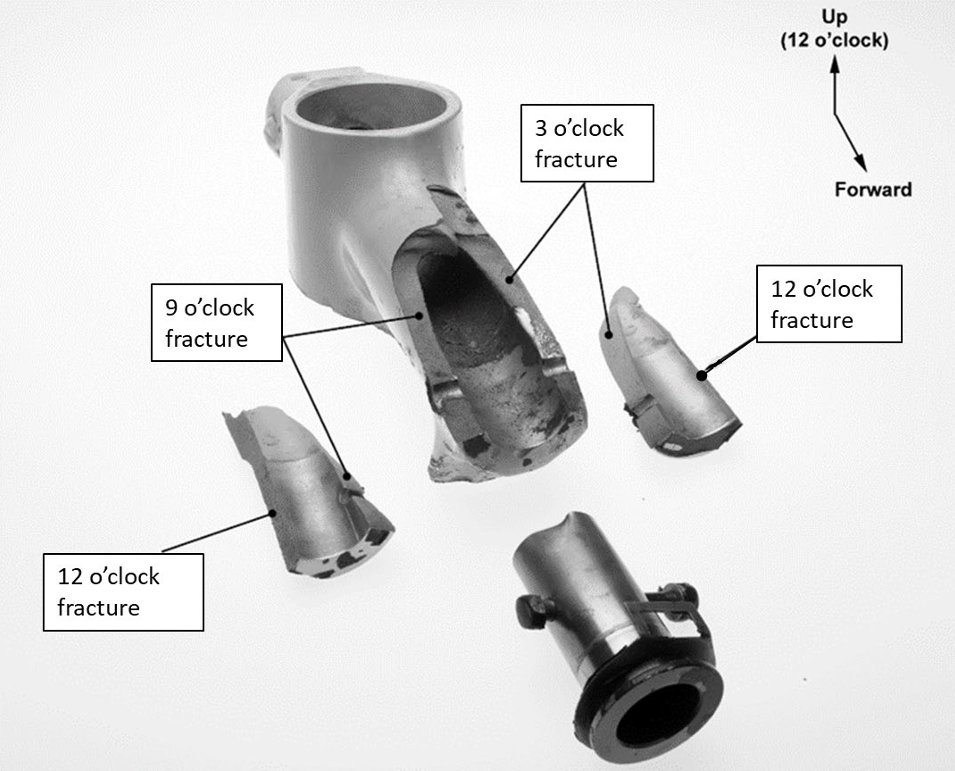
The aircraft remained upright during the landing but was substantially damaged when the left MLG unit collapsed as a result of a failed spigot housing. The left MLG unit, wing tip, propeller, and engine were significantly damaged, as was the belly cargo pod.
The accident was investigated by the Transportation Safety Board of Canada (TSB), in there extensive report they identified two Findings as to causes and/or contributing factors;
During the aircraft’s landing, several cracks in the spigot housing of the left main landing gear unit grew, to the point where the structure of the main landing gear unit failed. The cracks likely propagated because the material used was susceptible to stress corrosion cracking, and it was exposed to both tensile stress and a corrosive environment.
The required eddy current inspection method described in the service bulletin was unable to detect the defects observed on the occurrence spigot housing. As a result, these defects remained undetected during service and contributed to the failure of the spigot housing.
Additionally two Findings as to risk were identified;
If repair instructions contained within a service bulletin are not explicitly followed, there is a risk that the repair will be ineffective and the respective part will fail prematurely.
If service bulletins do not provide specific details, such as the requirements for chemical conversion coatings and the minimum required surface finish, the issue identified in the SB may not be adequately addressed.
The TSB report, which served as the source for this blog, containing all the investigation details can be accessed by clicking on the .pdf file below.



Comments