


15th of June 2014, Gear Failure, Blog #708

Updated: Jun 16, 2025
A Lockheed SP-2H Neptune was operating a firefighting mission when, after a successful aerial drop on a fire, the aircraft set course to Porterville Airport (California, USA).
During the completion of the descent checklist, the captain noticed the hydraulic pressure was indicating 0 psi. Subsequently, the first officer checked the sight gauge of the main hydraulic reservoir and found it was empty.
As the first officer opened the jet engine inlet doors the captain selected the landing gear down, however, the landing did not come down.
The captain informed the company via VHF of their situation and their intention to orbit to the east of the airfield to perform the necessary checklists and troubleshooting. After performing the required checklist it was confirmed that the nose landing gear was down, after which the first officer installed a safety pin in the nose landing gear. As per the emergency checklist.

It was decided to divert to Fresno Yosemite International Airport (California, USA), which has a much longer runway and better emergency services coverage than Porterville Airport. During the diversion, the first officer added 2 gallons of hydraulic fluid to the main reservoir. ATC was informed of the hydraulic failure. The captain attempted to lower the flaps but was unsuccessful, after which the crew briefed the no-flap landing procedure, airspeeds, and approach profile. The main landing gear was lowered using the emergency gear release as per the emergency checklist. This resulted in three down and locked landing gear indications in the cockpit.

The landing gear emergency extension checklist states the following items should be performed:
1. Normal landing gear circuit breaker pull
2. Airspeed below 155 KTS
3. Gear handle down
4. Emergency nose gear switch down
5. Nose gear pin install
6. Emergency nose gear switch off
7. MLG emergency release pulled
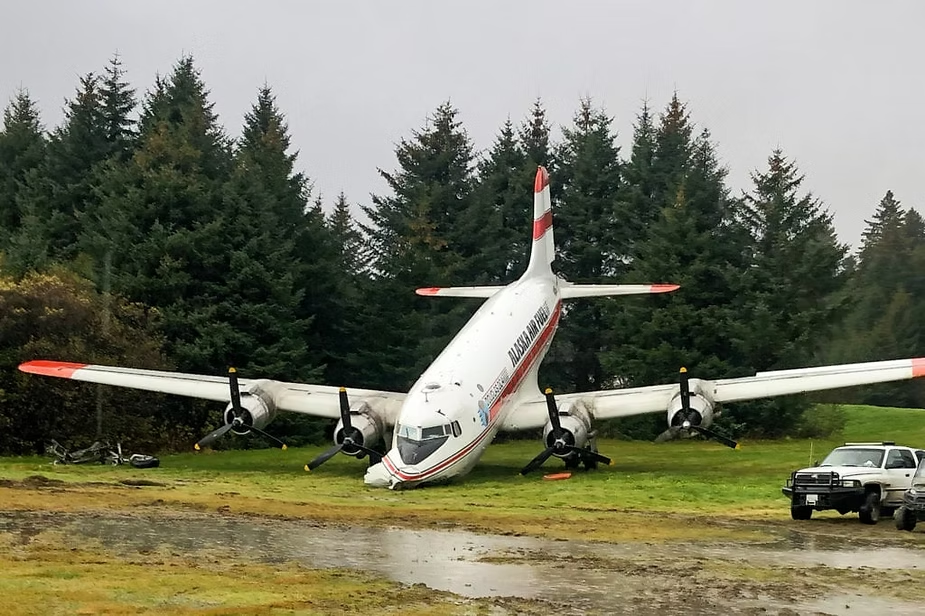
After a faster approach then normal the aircraft landed normally on runway 26R at Yosemite International Airport. During the landing roll the nose landing gear collapsed. The aircraft slid a short distance on its nose before coming to a stop in a nose-low position. An investigation was launched by the US Forest Service and the National Transportation Safety Board. The investigation revealed evidence of hydraulic fluid leakage from the right engine cowling drain. Examination of the right engine accessory pad revealed that two of the eight bolts attaching the hydraulic pump were separated. Hydraulic fluid was observed puddled in the lower cowling, and residual fluid was found on components in the vicinity to the hydraulic pump. The system was pressurized with the auxiliary pump, and no apparent leaking lines or fittings were noted. The engine was motored utilizing the starter, and fluid was observed dripping off the bottom of the hydraulic pump. Examination of the pump revealed that the outer portion of the case was cracked. The hydraulic pump drive shaft was rotated by hand. The pump was disassembled, and all internal components were intact and unremarkable. The backup ring was found partially extruded from the pump housing, which the technician stated was consistent with an over-pressurization event of the hydraulic system.

The nose gear pin was not located during the post-accident examination of the airplane. Installation of the nose gear pin is a critical step to be completed for a landing with a main hydraulic system failure. If not performed, the nose landing gear will collapse on touchdown. The installation of the pin requires a pilot to climb down into the nose landing gear wheel well that is located below the cockpit flight deck. While space is limited and it is difficult to maneuver within this area, the pin is installed while the nose landing gear door is already open and the gear is extended. The NTSB concluded that the probable cause(s) of this accident was:
The collapse of the nosewheel landing gear due to the disengagement of the nosewheel landing gear pin. Contributing to the accident was the failure of the main hydraulic system due to overpressurization for reasons that could not be determined during the post-accident examination of the airplane.
The NTSB report, which served as the source for this blog, can be accessed by clicking on the .pdf file below;


Comments